
HOW TO TAKE BODY MEASUREMENTS (GENERAL GUIDELINE)
VERY IMPORTANT STEP IN PATTERN CONSTRUCTION
If you are a beginner, its completely normal to feel a bit uncertain or overwhelmed when faced with the task of taking body measurement for your project. However, its important to remember that accurate measurements are crucial for achieving the desired outcome. Taking the time to carefully measure and record the necessary dimensions will greatly contribute to creating garments that fit well and make you feel confident. Keep in mind that everyones body is unique, so its important to create a personalized list of measurement that are specific to your project. By ensuring precision in your measurements, you will be on your way to creating garments that are tailored to your individual style and body shape. The number of measurements needed for each pattern can vary, and some measurements may feel long and overwhelming. However, it is important to be patient and allow for extra time during the initial stages. This investment will undoubtedly save you time and money in the long-run. Ensuring precise measurements is a crucial part of pattern making, as they determine the distances from the fundamental reference lines to the basic seam line of your garment. By taking accurate measurements, you establish a solid foundation for creating well-fitted garments.
Designing and crafting your own garment is truly a rewarding experience, offering a sense of fulfillment and delight. If you’re not yet ready to create your own blocks or patterns from scratch, you have the option to explore and purchase any of our available patterns. These patterns can serve as a helpful starting point to create the garments you desire. With a wide range of basic blocks to choose from, you can revamp your wardrobe and proudly showcase your unique creations to the world.
Please note that the following information is intended as a general guideline. You are welcome to use your own preferred method for taking measurements for your project.
Keep these important tips in mind when taking measurements:
- Use a flexible measuring tape: Ensure that your measuring tape is pliable and can easily wrap around the body without causing discomfort or distortion in the measurements.
- Stand naturally: Stand comfortably and naturally while taking measurements. Dont slouch or stand too stiffly, as it might affect the accuracy of the measurements.
- Not too tight, not too loose: The measuring tape should be snug against your body, but not too tight. It should show your bodys shape without squeezing or distorting.
- Wear the right undergarments: To get precise measurements, wear the undergarments you will be wearing with the garment you are making. This helps account for any extra bulk or support provided by specific undergarments.
- Get some help if needed: Though it is possible to take your own measurements, we suggest seeking help from someone else to ensure accurate and reliable measurements. This will minimize the chances of obtaining inaccurate or distorted measurements. It is also a good idea to gather measurements from a diverse range of individuals to better comprehend different body structures.
- Take measurements more than once: For better accuracy, take each measurement at least twice and compare the results. Consistency is important to ensure a well-fitted garment.
- Write it down right away: As you take the measurements, write them down immediately. This will prevent any confusion or forgetting later on. Good record-keeping is essential for pattern making and garment construction.
IMPORTANT STEP BEFORE TAKING MEASURMENTS
Body Marking: Prior to commencing the measurement process, it is imperative to clearly designate the following positions. These positions will be utilized repeatedly throughout the measurement-taking procedure and must remain consistent. To mark these points, you have the option to use a washable pencil in a darker shade, stickers, or pins. While taking measurements, it is crucial to ensure that the marked positions do not shift. In the diagram provided below, these positions are clearly indicated by blue markings.
- a. High Neck point
- b. Shoulder bone Point left and right
- c. Apex points
- d. Under Arm Point
- e. Waist Circumference
- f. Waist point left, right and the center
- g. Mid neck point front and back
How to locate these points:
- a. High Neck Point (Side of Neck): To establish the designated points, simply run your fingertips along the upper surface of the shoulder muscle and mark the spot where it intersects with the neck. Alternatively, you can have your model wear a thicker and longer chain adorned with a heavy pendant and identify the point where the chain rests on the neck.
- b. Shoulder Bone Point: Place your finger at the center of the model’s neck, near the top of the collarbone. Run your finger along the collarbone towards the shoulder until you reach the tip of the shoulder bone. This is the area where the arm bone connects to the shoulder bone. Keep your finger in this position and instruct your model to rub her palms together in a circular motion at chest height. You will sense movement at the tip of the bone. Once you identify this position, make a mark to indicate the shoulder bone point.
- c. Apex Points: Identify and mark the highest points of the bust on both apex points. This can be accomplished by stretching a ribbon across the bust point, ensuring it lightly touches the bust point, or alternatively, you can ask the model to directly indicate the apex point.
- d. Under Arm Point: Take a measuring tape and wrap it around the armhole, ensuring a comfortable fit. The tape should neither be too tight nor too loose. Once you are satisfied with the fit, mark this position. You can also record this measurement on your measurement sheet. Alternatively, you can have your model hold a ruler under her arm in a comfortable position and mark the corresponding point.
- e. Waist Circumference 1: Secure a string or a piece of inch elastic around the natural waist of the model. Instruct the model to bend from side to side and back to front until the elastic settles comfortably around her natural waist position. Keep this waistband in place while you proceed to take all the necessary measurements. You can also mark the position all around using an erasable pencil. The natural waistline typically falls approximately halfway between the ribcage and the belly button.
- f. Waist Circumference 2: Mark the sides and the mid-point of the waist
- g. Mid neck point front and back: Mark the points as shown in diagram (f1) below.
Important points to remember:
a – The measurements should be taken comfortably, ensuring a snug fit, unless stated otherwise. Make sure it is not too tight or too loose.
b – Hold the measuring tape firmly. It is recommended to measure multiple times to ensure accuracy. Even a small change in the position of the tape measure can have a noticeable effect on your measurements.
c – When taking horizontal measurements, it is important to keep your measuring tape parallel to the floor unless otherwise specified.
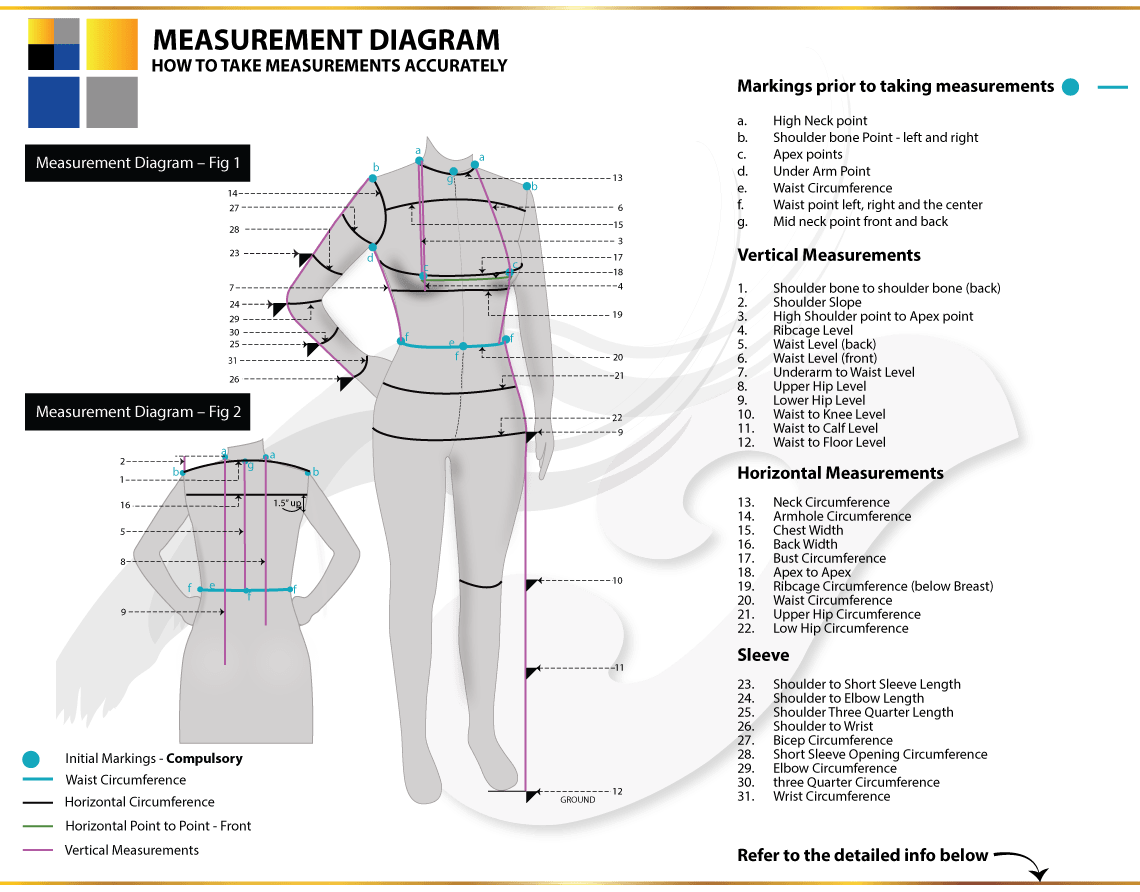
How to take the measurements. Refer to the above diagram.
It is essential to record all the measurements needed for your project as a precautionary measure, in case you need to double-check the pattern later on. At times more measurements is better. Please note that you may not end up using all of the measurements during the pattern creation process.
Vertical Measurements
- Shoulder bone to Shoulder Bone (back): To measure, position your measuring tape on the shoulder bone from the left shoulder bone, curving slightly up towards the neck bone, and then continue to the right shoulder bone. Once you are satisfied with the placement, record the measurements.
- Shoulder Slope: Instruct your model to stand against a wall. Place a straight ruler at the neck point, extending it beyond the shoulder point while keeping it parallel to the ground. Measure the distance between the shoulder bone and the ruler. Please refer to Fig 2 in the diagram.
- High Shoulder point to Apex point: Take the measurement starting from the point where the neck and shoulder meet, to the highest point of the bust.
- Ribcage Level: Take the measurement starting from the point where the neck and shoulder meet, passing above the highest point of the bust and ending at the ribcage. Make sure you take the curve bending the tape.
- Waste Level (back): Measure from the neck bone to the waist.
- Waist Level (front): Measure from the neck/shoulder point through above the apex to the Waist.
- Underarm to Waist Level: Measure from under arm point to waist.
- Upper Hip Level: Measure from the neck/shoulder point to smallest part of the hip. Record measurement.
- Lower Hip Level: Let the measuring tape hang loose from the shoulder/neck point at the back and mark the length where the tape touches the largest point of the hip.
- Waist to Knee Level: Measure from waist to knee level.
- Waist to Calf Level: Measure from Waist to Calf.
- Waist to Floor Level: Measure from Waist to Floor from the side of the body.
Horizontal Measurements:
- Neck Circumference: Run your tape measure around the neck comfortably and take the measurements.
- Armhole Circumference: Run the tape measure around the armhole comfortably and take the measurements.
- Chest Width: Measure 1.5 towards shoulder bone from the armhole line at both sides and measure the width of the distance from left to right. This is across front measurement.
- Back Width: Measure 1.5 towards shoulder bone from the armhole line at both sides and measure the width of the distance from left to right. This is across back measurement.
- Bust Circumference: To take the bust measurement, outstretch the arms across the body and place the measuring tape up around back shoulder blades and parallel to the ground. Bring the tape around the fullest part of the bust. While holding the tape in place, get your model to lower her arms. Your tape may expand slightly for the back expansion. Make sure your measuring tape remains parallel to the ground at the back, the sides and the front. If need be, measure twice to make sure you get this right. When you are happy, record your measurements
- Apex to Apex: Measure between Apex to Apex points and record this measurements. Proper bra should be worn.
- Ribcage Circumference (below breast): To take the ribcage measurements, spread your arms across the body and run your measuring tape just under your breast where normally the underwire of the bra sits. Now get your model to lower her arms and adjust the measuring tape until it sits perfectly. When you are happy, record your measurement. Always make sure measuring tape is parallel to the ground all around.
- Waist Circumference: Make sure the waist markings you have created earlier by tying an elastic has not shifted. It should be parallel to the ground and accurate. Run your measuring tape around this point and record your waist measurements. Do not take this measurement tight or loos.
- Upper Hip Circumference: Measure around the High Hip level parallel to the ground. This is more or less 3 4 inches below the waist line.
- Low Hip Circumference: Measure around the largest area of the Low Hip level parallel to the ground. This is more or less 6 9 inches below the waist line.
Sleeve
- Shoulder to Short Sleeve Length: Measure from the shoulder bone to the sleeve length of your choice.
- Shoulder to Elbow Length: Measure from Shoulder bone to Elbow bone. Keep your elbow slightly bent when taking this measurement.
- Shoulder to Three Quarter Length: Measure from Shoulder bone to where the three quarter length mussel ends. Keep your elbow slightly bent when taking this measurement.
- Shoulder to Wrist: Measure from Shoulder bone to wrist level. Keep your elbow slightly bent when taking this measurement.
- Bicep Circumference: Instruct the individual to firmly place two fingers beneath her armpit. Then ask her to turn around and indicate the point where the bottom of the lower finger intersects with the arm. Once this point has been marked, ask her to relax her hands while you carefully measure the complete circumference of the arm at the marked location using a measuring tape. Remember to record the measurements.
- Short Sleeve Opening Circumference: Measure the circumference of the arm where you have marked as short sleeve.
- Elbow Circumference: Get your model to bend her arm slightly and measure the circumference of the elbow.
- Three quarter Circumference: While keeping your arms slightly bent, measure the circumference of your models three quarter length.
- Wrist Circumference: measure around the wrist bone.
You may need the following additional measurement if you are making a pant, dungaree etc.
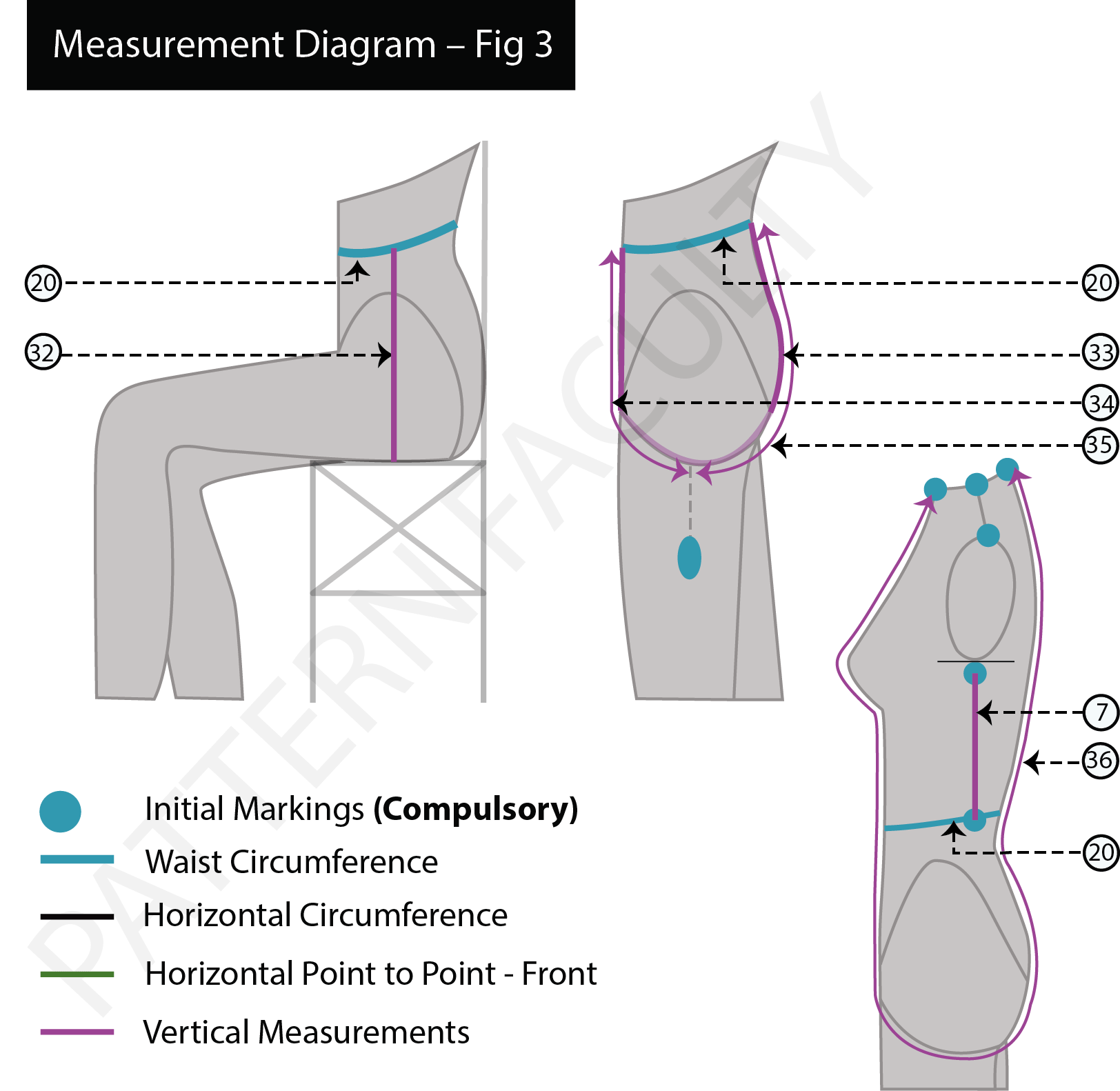
- Crotch height: Make your model sit on a chair and measure the distance from the waist to the seat.
- Crotch to waist: Measure the distance from the front waist to the back waist, as indicated in the diagram. Make sure it is comfortable. Not too tight or too loose.
- Front Crotch: Measure from the front waist to the middle of the crotch area.
- Back Crotch: Measure from the back waist to the middle of the crotch area.
- Full crotch: Using the diagram provided, measure the distance from the front neck point, passing over the bust and following the bust curve. Then continue measuring from the crotch area to the back of the neck.
Please keep in mind that the instructions provided are just general guidelines, and you are free to use any other method that you prefer or find more suitable.
Creating your own unique piece of clothing can bring immense joy and satisfaction. If you’re not ready to make your own blocks or patterns, you can choose from our selection of patterns to create the garments you need. We offer various basic blocks that can serve as a starting point for creating a brand new wardrobe. You can proudly showcase your creations to the world, knowing that you made them yourself.